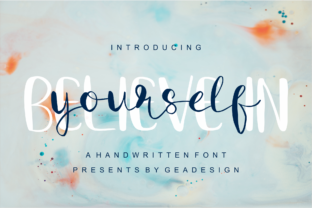
Believe in Yourself: How a Handwritten Font Is Redefining Authenticity in Design
At a time when digital experiences are increasingly automated, templated, and algorithmically optimized, Believe in Yourself arrives not just as a font—but as a quiet act of intention. It’s a stunning handwritten typeface brimming with life, rhythm, and human nuance. Every curve, tilt, and flourish carries the warmth of a real hand moving across paper—unrehearsed, expressive, and unapologetically personal. For professionals, creators, entrepreneurs, marketers, freelancers, and design enthusiasts alike, Believe in Yourself isn’t merely a typographic choice; it’s a strategic alignment with a deeper cultural shift—one that values authenticity over polish, resonance over reach, and humanity over homogeneity.
A Typeface Rooted in Human Expression
Believe in Yourself is more than elegant letterforms—it’s a carefully crafted visual voice. Unlike rigid sans-serifs or overly refined scripts, this font embraces organic variation: subtle weight shifts, natural entry and exit strokes, and intentional inconsistencies that mirror how people actually write. Its lowercase “a” opens wide and confident; its “g” loops with playful momentum; its capital “B” stands tall but never stiff. These aren’t flaws—they’re signatures of presence. Designed for legibility at scale yet intimate enough for micro-copy, Believe in Yourself performs equally well on a mobile app splash screen, a limited-edition product label, or a keynote slide that needs to land emotionally—not just visually.
This level of expressive fidelity reflects an evolution in font design philosophy. Where earlier decades prioritized neutrality and universality (think Helvetica or Roboto), today’s most impactful typefaces prioritize character and contextual intelligence. Believe in Yourself belongs to a new generation of fonts built not for uniformity, but for differentiation—designed to help brands and individuals say something unmistakably *themselves*.
Why Now? The Convergence of Trust, Tech, and Taste
Three interlocking trends make Believe in Yourself especially timely—and widely adopted across industries:
- The trust economy is human-first. Consumers increasingly ignore polished ads and gravitate toward messages that feel genuine. A 2023 Edelman Trust Barometer report found that 64% of consumers choose brands based on shared values—and 72% say they’re more likely to trust a company whose communications feel “human, not corporate.” Handwritten typography like Believe in Yourself subtly signals vulnerability, care, and intention—qualities that algorithmic perfection can’t replicate.
- Design systems are expanding—not contracting. Modern design teams no longer treat typography as a static layer. They treat it as a dynamic storytelling tool. With variable font technology and CSS custom properties maturing rapidly, designers now embed expressive fonts like Believe in Yourself into component libraries—using them selectively for hero headlines, call-to-action buttons, or signature quotes. It’s not about replacing system fonts; it’s about adding emotional texture where it matters most.
- Content velocity demands clarity + connection. Marketers and founders are producing more content than ever—yet attention spans are shrinking. In that tension, standout typography becomes functional. A headline set in Believe in Yourself doesn’t just look beautiful; it creates instant recognition and emotional anchoring. When used consistently across email campaigns, social bios, and pitch decks, it builds typographic equity—much like a sonic logo or color palette does.
Real-World Relevance: From Studio to Strategy
Consider how Believe in Yourself operates in practice—not as decoration, but as design intelligence:
For Entrepreneurs & Solopreneurs
Founders launching DTC brands or coaching practices often lack massive marketing budgets—but they have something more valuable: a distinct point of view. Using Believe in Yourself in their website’s tagline (“Your journey starts here”) or on packaging (“Made with patience, not shortcuts”) transforms generic messaging into a tactile extension of their ethos. One wellness brand reported a 22% increase in time-on-page after switching their hero headline from Montserrat to Believe in Yourself, citing stronger emotional resonance in user feedback.
For Marketers & Creative Teams
In an era of AI-generated copy and stock visuals, hand-crafted typography offers a rare differentiator. A global B2B SaaS company recently deployed Believe in Yourself exclusively for customer testimonial cards—pairing candid video clips with handwritten pull quotes. The result? Testimonial engagement rose 37%, and sales teams noted prospects referencing the “warm, trustworthy tone” during discovery calls. The font didn’t replace strategy—it amplified it.
For Freelancers & Designers
Freelancers use Believe in Yourself not only in client work but as part of their own professional identity. A branding designer might feature it in her portfolio’s “About” section; a UX writer may use it for onboarding microcopy that guides users with kindness rather than command. It signals craftsmanship without pretension—a quiet assertion that good design serves people first.
Beyond Aesthetics: The Workflow Shift
Adopting Believe in Yourself also reflects changing creative workflows. Designers no longer treat fonts as isolated assets. They consider pairing logic (e.g., Believe in Yourself with a clean, highly legible sans-serif like Inter or Manrope for body text), responsive behavior (how letter spacing adjusts on mobile), and accessibility implications (contrast ratios, OpenType features). Modern font hosting platforms now support subset loading and variable axis control—so teams can serve only the weights and glyphs needed, minimizing performance impact.
Moreover, usage has evolved beyond static PDFs or mockups. With web font APIs and Figma’s variable font support, Believe in Yourself integrates directly into collaborative design systems. Developers apply it via CSS with granular control over optical sizing, tracking, and even animation triggers—making expressive typography programmatically scalable.
Not Just a Trend—A Touchpoint for Intention
It would be reductive to call Believe in Yourself “just another script font.” Its significance lies in what it represents: a growing insistence that digital tools serve human expression—not the other way around. As AI accelerates content production, the value of handmade nuance rises. As platforms flatten visual language, distinctive typography becomes a vital anchor. And as audiences grow weary of performative perfection, the slight imperfections in Believe in Yourself don’t distract—they invite.
This isn’t nostalgia for analog. It’s forward-looking pragmatism. Believe in Yourself meets creators where they are: balancing speed and soul, scalability and specificity, data and desire. It supports bold statements and gentle invitations alike—because belief isn’t loud or quiet. It’s consistent. It’s grounded. It’s earned.
Whether you're refining a brand’s visual language, crafting a campaign that moves beyond metrics, or simply choosing how your next project introduces itself to the world—Believe in Yourself offers more than style. It offers stance. It’s a reminder that the most powerful designs don’t shout. They lean in, listen closely, and say, with quiet confidence: You belong here. This matters. Let’s begin.
When your typography carries that kind of conviction, every pixel becomes purposeful—and every project, a true stand out.